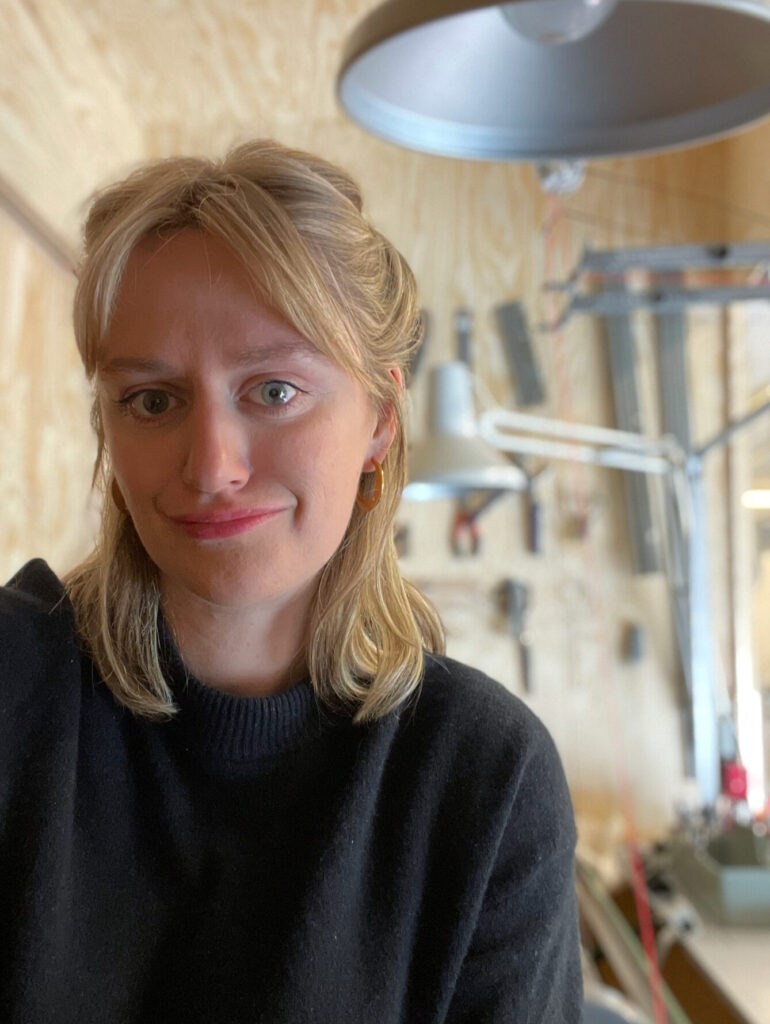
An Interview with Maureen Selina Laverty
Ahead of her creative talk for us as part of Belfast Design Week Maureen Selina Laverty has done this brilliant interview for us on her path to becoming a designer, her recent move back to Northern Ireland from Norway and the differences she has noticed between working as a designer in both countries.
What inspired you to become a designer and how did you first get started?
I didn’t grow up in a family or community where I knew anyone making a living from a creative practice. I remember having a strong conviction that design shaped everyone’s experience of the world – I’m not sure how I landed on that. My grandmother knitted and my mother sewed, so clothing seemed the most tangible design path in my childhood. I got my break in menswear in London on Savile Row and at Alexander McQueen. I liked the thrill of chancing my arm in spaces where I ought not to be. I learned a lot about materiality, craftsmanship, and shaping popular culture. Eventually, designing exclusively for the rich and famous didn’t sit well with me. At the time, the only alternative was designing for fast fashion, which exploits the environment and communities in other parts of the world – that didn’t sit well either. My career has taken many twists and turns in pursuit of translating skills garnered in the luxury market to craft more equitable and accessible care through design: from wearable medical devices, to wheelchair attachments, to participatory design with Disabled communities, to speculative fashion systems.
You recently moved back to Northern Ireland, what inspired the move and how have you found it so far?
Norway was such an enriching experience, but I deeply missed being part of my community. Belfast has transformed so much in the last 20 years. The design industry is thriving. I am very privileged to have a studio space on Hill St, surrounded by beautifully designed regenerated spaces. Juxtaposed to this is the homelessness on the same street; people ravished by trauma, relying on incredible volunteer organisations to survive. I left a few years after we voted for cultural equality – but returned to find a huge wealth inequality. It’s been very confronting as an adult, to realise how exclusion has been purposefully designed here: archaic public transport systems that still splits the city into quadrants, poor quality social housing, education systems that determine your value at age 11, urban design that deliberately cuts communities off from the rest of the city and means that their challenges are conveniently out of sight. To call myself an inclusive designer in this context feels very naive, comparatively within Norwegian egalitarianism. I’m still unravelling how my experience and skills can be translated here to make meaningful change within my own community.
Are there any differences you have noticed between working as a designer in both countries?
In Norway good design is for everyone. It permeates every part of society – from beautiful wooden chairs that pass through generations, to public transport systems that smoothly connect remote islands, to adaptable free education systems, to government systems that splits fully paid paternity leave between both parents. Its foundations are built on respect for nature and each other. It uses indigenous materials and craftsmanship. Here we are so disconnected from our land – but there are wonderful grass roots organisations working to reconnect us. In Scandinavia everyone has basic skills in building, care, and repair so they can invest in longevity rather than passing trends. This also facilitates self-determination through design. Participatory ways of working and decision making ensure all voices are heard. Design purposefully crafts equality. Here it sometimes feels like design is used to elevate one person’s experience of the world over another’s. I find this very difficult to wrap my head around. Conversely, the thing Belfast does best is impassioned communities. My favourite thing about being back are the random curious conversations with strangers – not an activity favoured by Norwegians! We are great storytellers, but I believe we are even better listeners. I’m excited about exploring how we can harness these attributes in participatory design to improve people’s quality of life.
You can find out more about Maureen on her website https://www.maureenselinalaverty.com/ or on instagram https://www.instagram.com/maureenselinalaverty/
Details on Maureen’s Creative Talk
Event Date: Tuesday 5th May
Event Time: 7.00-8.00pm
Location: Blick Shared Studios, 46 Hill Street, Belfast, BT1 2LB
Cost: Free
Book tickets: https://blickstudios.org/events/blick-creative-talk-maureen-laverty-product-and-fashion-designer/